
From Angry Calls to Self-Serve Clarity: Bonus Interest Tracker
The Problem: The call centre was overwhelmed by customers calling to ask about their bonus interest to see if they qualified or why haven't they got paid. Those calls were costly, time-consuming, and left customers more frustrated than before.
The Business Impact: Bonus interest queries were a small share of total complaints, but disproportionately expensive. Each one required individual handling, draining call centre capacity and driving down App Store ratings across all three brands.
My Role: I led the end-to-end research and synthesis that revealed some compounding failures:
Unclear eligibility criteria
Invisible progress tracking
No payment timeline
The criteria itself was genuinely complex and transparency alone couldn't solve it.
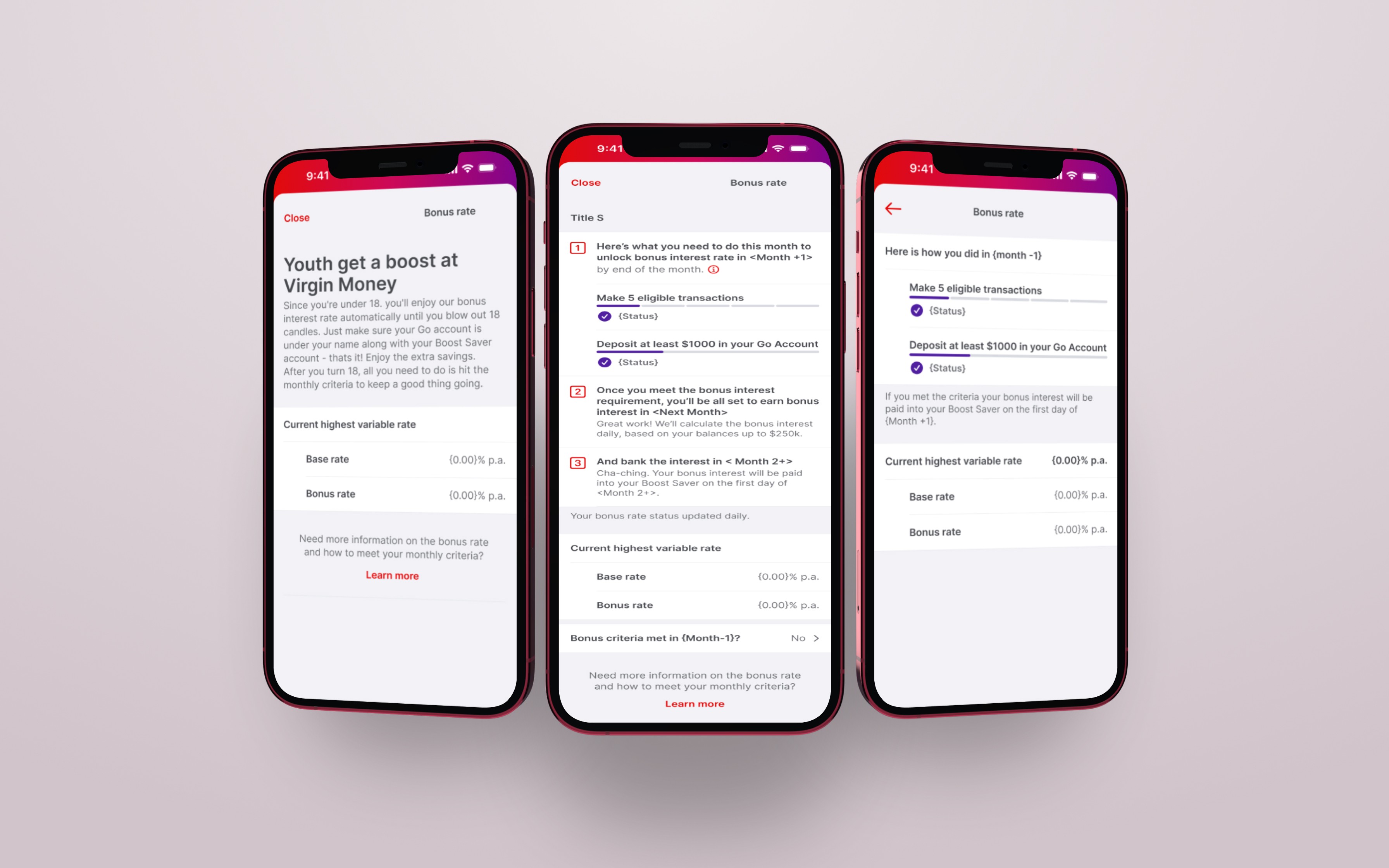
The Outcome: From those findings I designed, iterated and delivered a self-service clarity tracker across 3 brands and 5 products. This was the first time customers had visibility, control and confidence in one place. Research also gave the business evidence that the remaining confusion wasn't a design failure, but a product complexity problem. Two outcomes. One solved through design. One handed to the business as a strategic decision.
Client
Virgin Money | ME Bank | Bank of Queensland
Role
Lead Researcher | UX/UI Designer
Stakeholders
Product Lead | Development Lead | Design Lead | Compliance Team
/ Context
3
brands, Mobile-first feature parity (untested assumption)
2
Legacy platforms overdue for retirement
33
%
Customers aged 66+, making accessibility non-negotiable
215K
+
Customers to migrate without losing trust or confidence
How might we replace outdated systems with a modern platform that scales across brands and feels seamless for every customer ?
/ Discovery
Experience Mapping
We mapped the product criteria and user journey to identify friction points in tracking bonus interest. By analysing app interactions, call centre logs, and user feedback, we uncovered transparency gaps that led to confusion and high support demand. These insights shaped our design hypothesis.
Competitor Analysis
We audited 5 competitor banking apps to benchmark how the market handled bonus interest visibility. The gap was clear: most competitors either lacked a tracker entirely or buried eligibility criteria. That absence validated the opportunity, and the table below shows exactly where the market fell short.
Prototyping
We then designed a series of prototypes in preparation for usability testing.

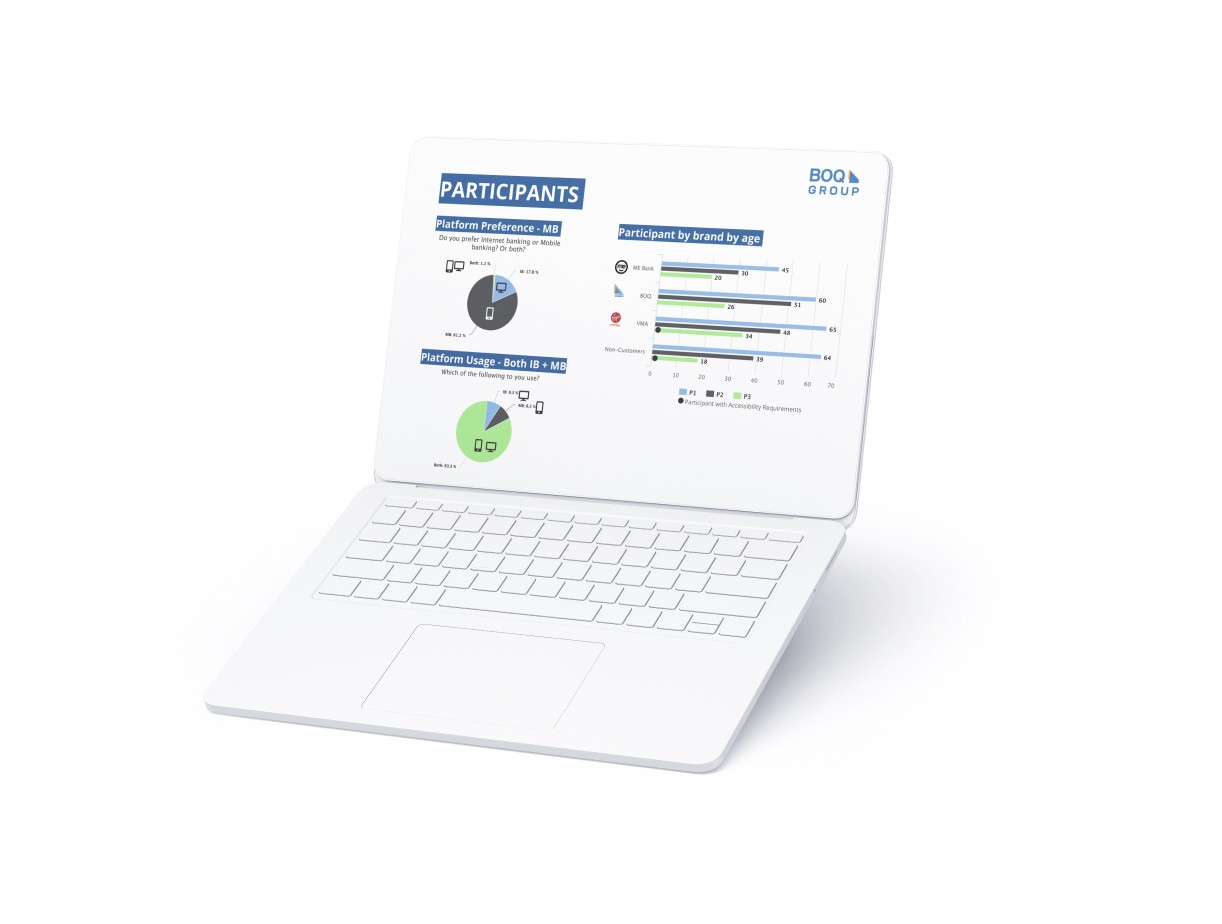
Task-Centric Mental Models
Theme
Users preferred Internet Banking for complex, information-heavy tasks when depth and control mattered more than convenience.
Insight
Feature Expectations
Theme
Users wanted advanced tools on desktop—search, filters, personalisation—not just mobile parity.
Insight
Password-Less Login
Theme
Users favoured secure, seamless login over traditional passwords—accessibility and ease won.
Insight
Support Preferences
Theme
In-app chat beat call centres for quick help; calls were reserved for complex needs.
Insight
Usability Testing
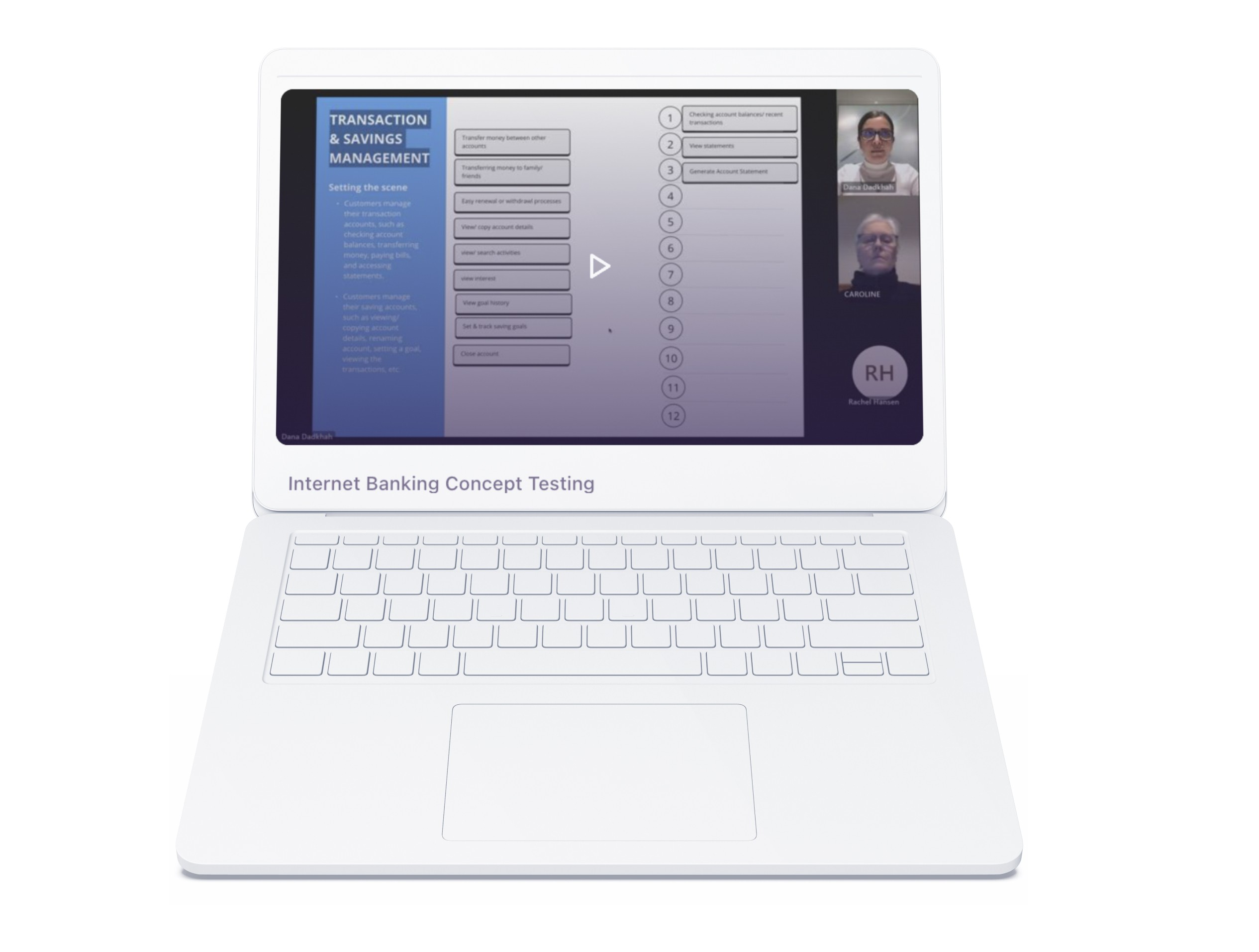
I recruited and led 6 moderated sessions across 8 prototype variations. Testing revealed users values the visual tracker and understood each element in isolation, but couldn't connect the criteria, timeline, and tracker into a coherent picture. The hierarchy wasn't guiding them through the information gradually. That insight shifted the iteration priority from visual refinement to information architecture.
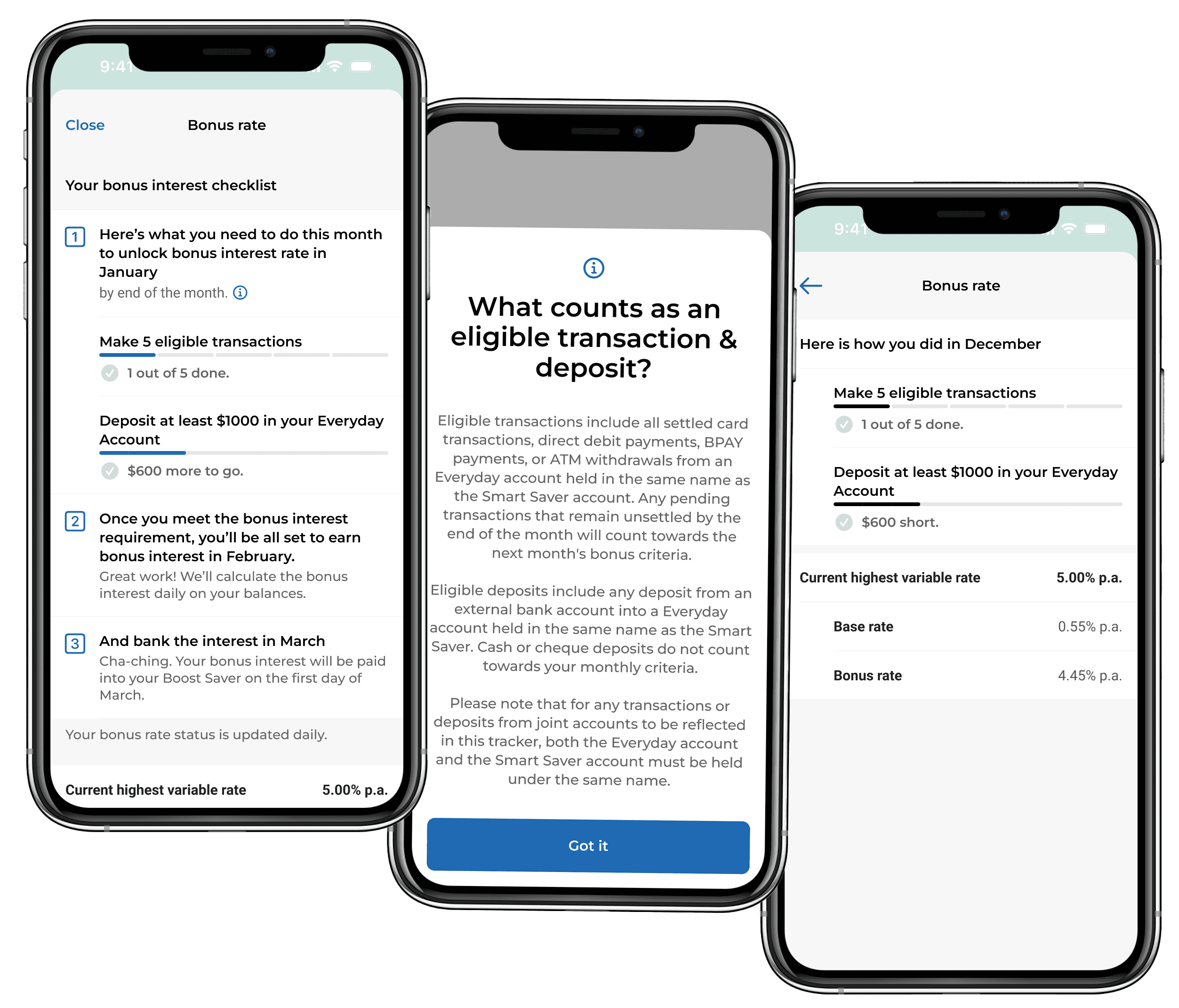
Users loved the visual tracker, but struggled to piece together fragmented copy, navigate the cluttered layout, and follow unclear instructions.
/ Design
Redesigned for clarity, usability, and actionability
I led and executed each design iteration based on a specific research finding. The priority was information hierarchy first, making the criteria, timeline, and tracker readable as a connected system before refining the visual layer.
Edge Cases
Not all users fit the standard flow. I designed for welcome bonus recipients and under-18 accounts among other edge cases that would have created confusion or exclusion if left unaddressed.
Design Hand-off
I worked directly with the senior UI designer to adapt the tracker across three brand design systems, and aligned with developers early to surface feasibility constraints before final handover, not after.
/ Impact
Refined Personas & Mental Models
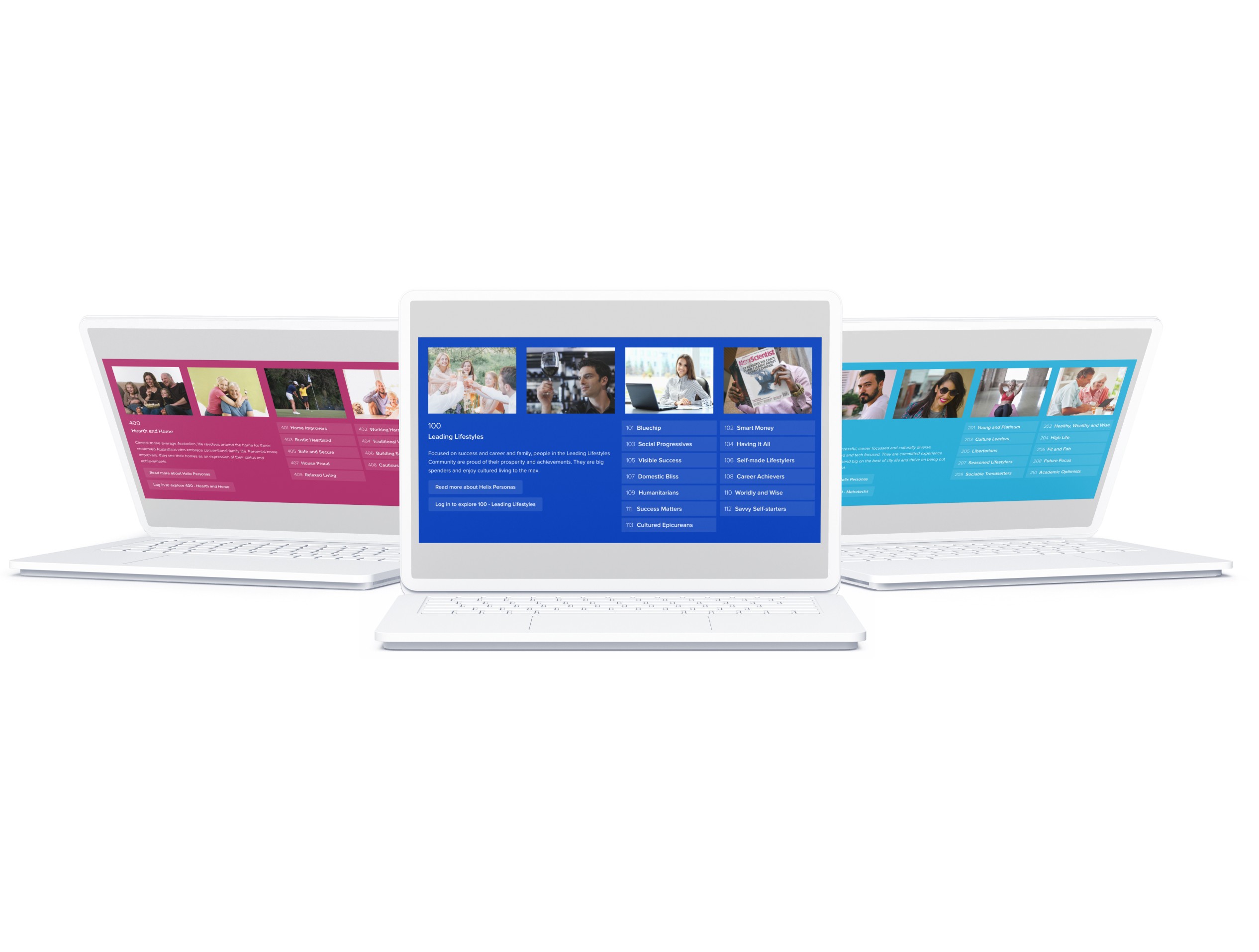
We moved away from age- and demographic-based personas, focusing instead on users’ task mindsets. Internet Banking users valued depth and detail; Mobile Banking users preferred speed and simplicity for quick wins like alerts.
Feature Expansion vs Feature Parity
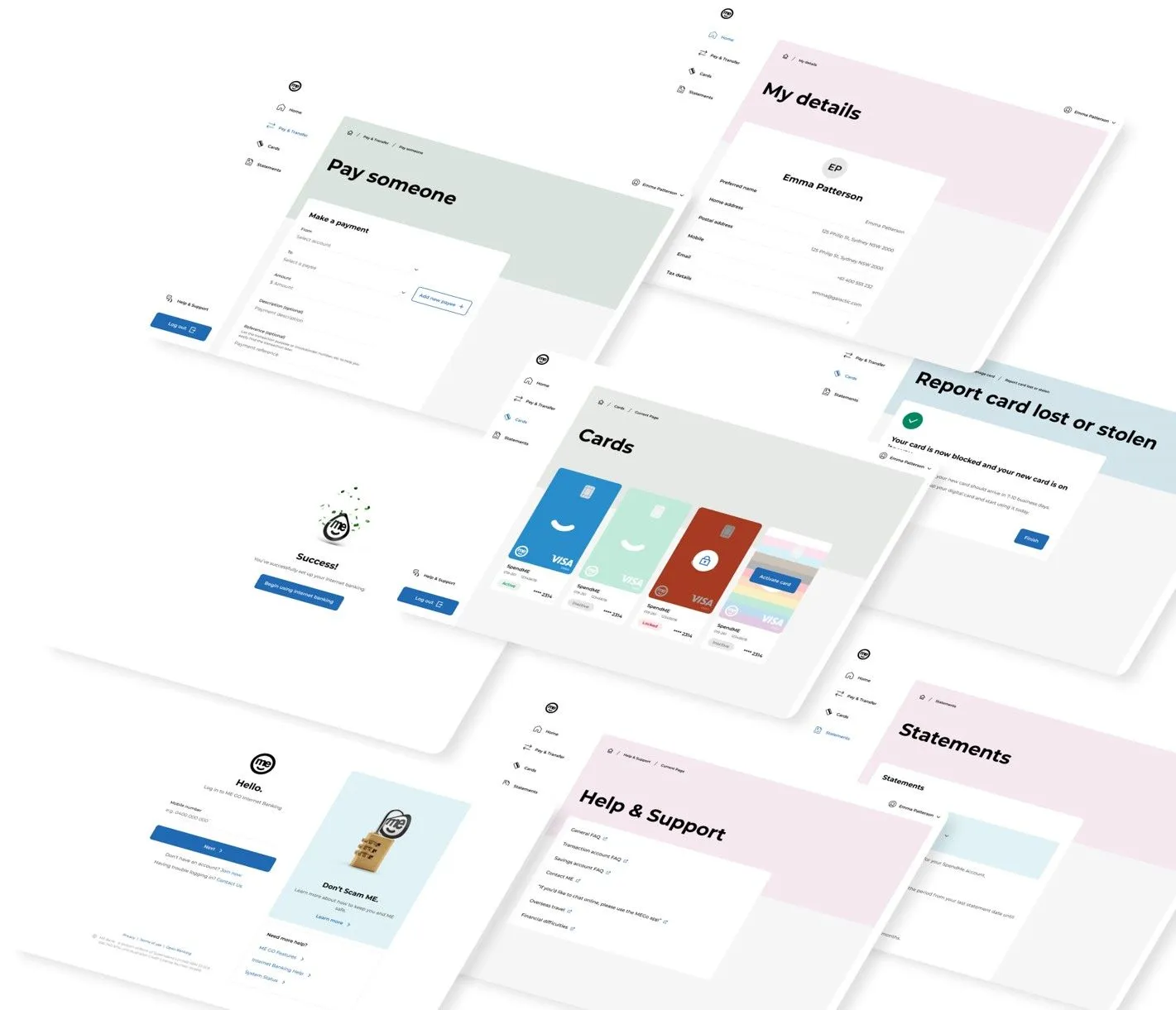
We shifted from a rigid mobile-first approach to a context-first strategy. Desktop became the hub for heavy-lift tasks; mobile stayed lean for on-the-go needs. Each platform played to its strengths.
Successful Migration
Research-grounded design reduced contact centre dependency and gave users a migration experience that didn't erode trust which was the baseline goal for 215k customers.
/ Reflection
Reusable Research Templates
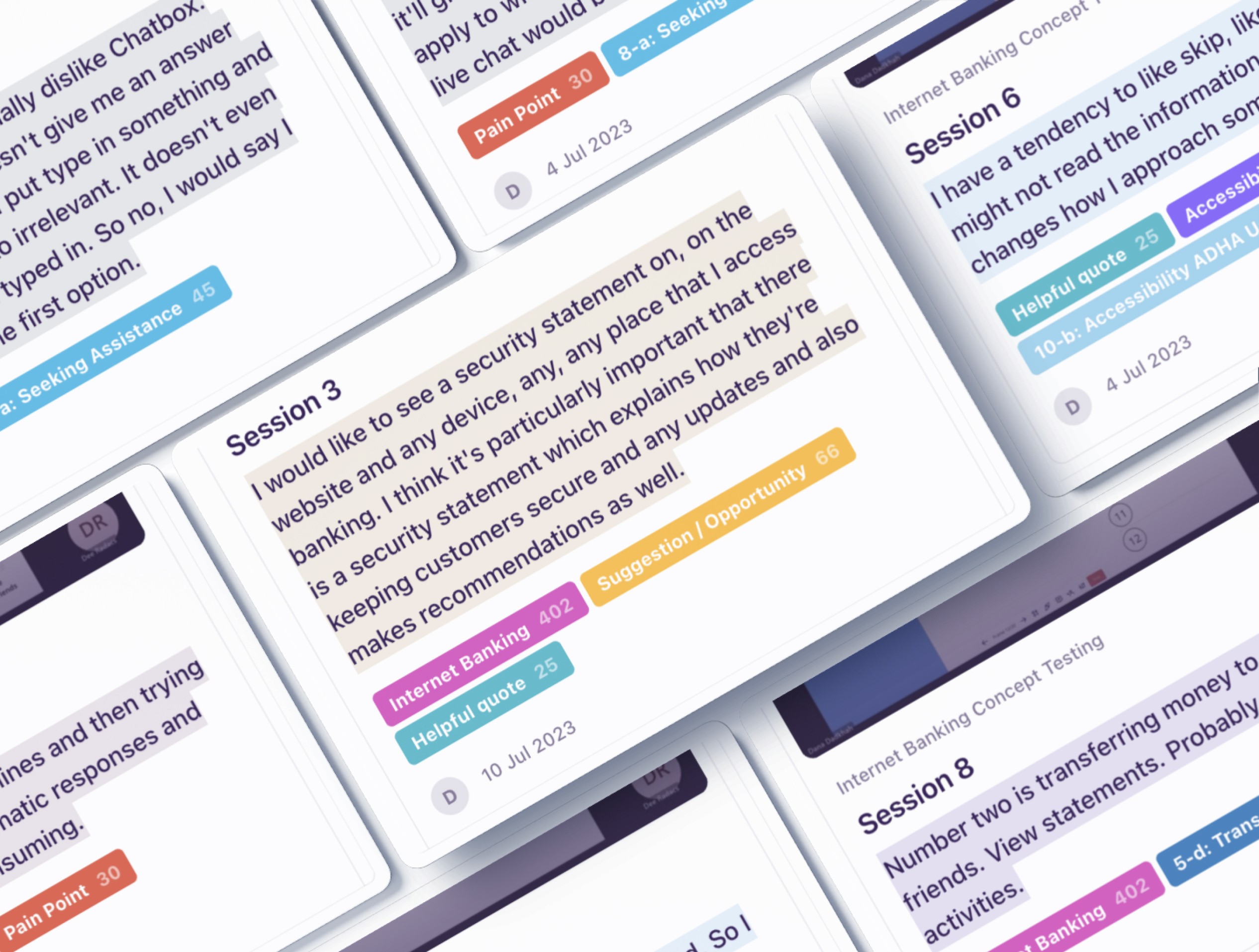
Post-project, I built standardised Dovetail templates and global tagging systems. These cut synthesis time and made cross-project collaboration seamless.
Upgraded Playback & Insights
I redesigned the playback format, adding a section for core user pain points and behaviour patterns. This made findings easier to action and improved design alignment across teams.
Deeper Stakeholder Alignment
We hosted inclusive workshops that invited candid feedback and collective decisions, which built trust and shifted how the organisation valued research input.
From Angry Calls to Self-Serve Clarity: Bonus Interest Tracker
The Problem: The call centre was overwhelmed by customers calling to ask about their bonus interest to see if they qualified or why haven't they got paid. Those calls were costly, time-consuming, and left customers more frustrated than before.
The Business Impact: Bonus interest queries were a small share of total complaints, but disproportionately expensive. Each one required individual handling, draining call centre capacity and driving down App Store ratings across all three brands.
My Role: I led the end-to-end research and synthesis that revealed some compounding failures:
Unclear eligibility criteria
Invisible progress tracking
No payment timeline
The criteria itself was genuinely complex and transparency alone couldn't solve it.
The Outcome: From those findings I designed, iterated and delivered a self-service clarity tracker across 3 brands and 5 products. This was the first time customers had visibility, control and confidence in one place. Research also gave the business evidence that the remaining confusion wasn't a design failure, but a product complexity problem. Two outcomes. One solved through design. One handed to the business as a strategic decision.
Client
Virgin Money | ME Bank | Bank of Queensland
Role
Lead Researcher | UX/UI Designer
Stakeholders
Product Lead | Development Lead | Design Lead | Compliance Team
/ Context
3
brands, Mobile-first feature parity (untested assumption)
2
Legacy platforms overdue for retirement
33
%
Customers aged 66+, making accessibility non-negotiable
215K
+
Customers to migrate without losing trust or confidence
How might we replace outdated systems with a modern platform that scales across brands and feels seamless for every customer ?
/ Discovery
Experience Mapping
We mapped the product criteria and user journey to identify friction points in tracking bonus interest. By analysing app interactions, call centre logs, and user feedback, we uncovered transparency gaps that led to confusion and high support demand. These insights shaped our design hypothesis.
Competitor Analysis
We audited 5 competitor banking apps to benchmark how the market handled bonus interest visibility. The gap was clear: most competitors either lacked a tracker entirely or buried eligibility criteria. That absence validated the opportunity, and the table below shows exactly where the market fell short.
Prototyping
We then designed a series of prototypes in preparation for usability testing.
Task-Centric Mental Models
Theme
Users preferred Internet Banking for complex, information-heavy tasks when depth and control mattered more than convenience.
Insight
Feature Expectations
Theme
Users wanted advanced tools on desktop—search, filters, personalisation—not just mobile parity.
Insight
Password-Less Login
Theme
Users favoured secure, seamless login over traditional passwords—accessibility and ease won.
Insight
Support Preferences
Theme
In-app chat beat call centres for quick help; calls were reserved for complex needs.
Insight
Usability Testing
I recruited and led 6 moderated sessions across 8 prototype variations. Testing revealed users values the visual tracker and understood each element in isolation, but couldn't connect the criteria, timeline, and tracker into a coherent picture. The hierarchy wasn't guiding them through the information gradually. That insight shifted the iteration priority from visual refinement to information architecture.
Users loved the visual tracker, but struggled to piece together fragmented copy, navigate the cluttered layout, and follow unclear instructions.
/ Design
Redesigned for clarity, usability, and actionability
I led and executed each design iteration based on a specific research finding. The priority was information hierarchy first, making the criteria, timeline, and tracker readable as a connected system before refining the visual layer.
Edge Cases
Not all users fit the standard flow. I designed for welcome bonus recipients and under-18 accounts among other edge cases that would have created confusion or exclusion if left unaddressed.
Design Hand-off
I worked directly with the senior UI designer to adapt the tracker across three brand design systems, and aligned with developers early to surface feasibility constraints before final handover, not after.
/ Impact
Refined Personas & Mental Models
We moved away from age- and demographic-based personas, focusing instead on users’ task mindsets. Internet Banking users valued depth and detail; Mobile Banking users preferred speed and simplicity for quick wins like alerts.
Feature Expansion vs Feature Parity
We shifted from a rigid mobile-first approach to a context-first strategy. Desktop became the hub for heavy-lift tasks; mobile stayed lean for on-the-go needs. Each platform played to its strengths.
Successful Migration
Research-grounded design reduced contact centre dependency and gave users a migration experience that didn't erode trust which was the baseline goal for 215k customers.
/ Reflection
Reusable Research Templates
Post-project, I built standardised Dovetail templates and global tagging systems. These cut synthesis time and made cross-project collaboration seamless.
Upgraded Playback & Insights
I redesigned the playback format, adding a section for core user pain points and behaviour patterns. This made findings easier to action and improved design alignment across teams.
Deeper Stakeholder Alignment
We hosted inclusive workshops that invited candid feedback and collective decisions, which built trust and shifted how the organisation valued research input.
From Angry Calls to Self-Serve Clarity: Bonus Interest Tracker
The Problem: The call centre was overwhelmed by customers calling to ask about their bonus interest to see if they qualified or why haven't they got paid. Those calls were costly, time-consuming, and left customers more frustrated than before.
The Business Impact: Bonus interest queries were a small share of total complaints, but disproportionately expensive. Each one required individual handling, draining call centre capacity and driving down App Store ratings across all three brands.
My Role: I led the end-to-end research and synthesis that revealed some compounding failures:
Unclear eligibility criteria
Invisible progress tracking
No payment timeline
The criteria itself was genuinely complex and transparency alone couldn't solve it.
The Outcome: From those findings I designed, iterated and delivered a self-service clarity tracker across 3 brands and 5 products. This was the first time customers had visibility, control and confidence in one place. Research also gave the business evidence that the remaining confusion wasn't a design failure, but a product complexity problem. Two outcomes. One solved through design. One handed to the business as a strategic decision.
Client
Virgin Money | ME Bank | Bank of Queensland
Role
Lead Researcher | UX/UI Designer
Stakeholders
Product Lead | Development Lead | Design Lead | Compliance Team
/ Context
3
Complex Products, 3 Brands, 2 Platforms
2
Legacy platforms overdue for retirement
33
%
Customers aged 66+, making accessibility non-negotiable
215K
+
Customers to migrate without losing trust or confidence
How might we replace outdated systems with a modern platform that scales across brands and feels seamless for every customer ?
/ Discovery
Experience Mapping
We mapped the product criteria and user journey to identify friction points in tracking bonus interest. By analysing app interactions, call centre logs, and user feedback, we uncovered transparency gaps that led to confusion and high support demand. These insights shaped our design hypothesis.
Competitor Analysis
We audited 5 competitor banking apps to benchmark how the market handled bonus interest visibility. The gap was clear: most competitors either lacked a tracker entirely or buried eligibility criteria. That absence validated the opportunity, and the table below shows exactly where the market fell short.
Prototyping
We then designed a series of prototypes in preparation for usability testing.
Task-Centric Mental Models
Theme
Users preferred Internet Banking for complex, information-heavy tasks when depth and control mattered more than convenience.
Insight
Feature Expectations
Theme
Users wanted advanced tools on desktop—search, filters, personalisation—not just mobile parity.
Insight
Password-Less Login
Theme
Users favoured secure, seamless login over traditional passwords—accessibility and ease won.
Insight
Support Preferences
Theme
In-app chat beat call centres for quick help; calls were reserved for complex needs.
Insight
Usability Testing
I recruited and led 6 moderated sessions across 8 prototype variations. Testing revealed users values the visual tracker and understood each element in isolation, but couldn't connect the criteria, timeline, and tracker into a coherent picture. The hierarchy wasn't guiding them through the information gradually. That insight shifted the iteration priority from visual refinement to information architecture.
Users loved the visual tracker, but struggled to piece together fragmented copy, navigate the cluttered layout, and follow unclear instructions.
/ Design
Redesigned for clarity, usability, and actionability
I led and executed each design iteration based on a specific research finding. The priority was information hierarchy first, making the criteria, timeline, and tracker readable as a connected system before refining the visual layer.
Edge Cases
Not all users fit the standard flow. I designed for welcome bonus recipients and under-18 accounts among other edge cases that would have created confusion or exclusion if left unaddressed.
Design Hand-off
I worked directly with the senior UI designer to adapt the tracker across three brand design systems, and aligned with developers early to surface feasibility constraints before final handover, not after.
/ Impact
Refined Personas & Mental Models
We moved away from age- and demographic-based personas, focusing instead on users’ task mindsets. Internet Banking users valued depth and detail; Mobile Banking users preferred speed and simplicity for quick wins like alerts.
Feature Expansion vs Feature Parity
We shifted from a rigid mobile-first approach to a context-first strategy. Desktop became the hub for heavy-lift tasks; mobile stayed lean for on-the-go needs. Each platform played to its strengths.
Successful Migration
Research-grounded design reduced contact centre dependency and gave users a migration experience that didn't erode trust which was the baseline goal for 215k customers.
/ Reflection
Reusable Research Templates
Post-project, I built standardised Dovetail templates and global tagging systems. These cut synthesis time and made cross-project collaboration seamless.
Upgraded Playback & Insights
I redesigned the playback format, adding a section for core user pain points and behaviour patterns. This made findings easier to action and improved design alignment across teams.
Deeper Stakeholder Alignment
We hosted inclusive workshops that invited candid feedback and collective decisions, which built trust and shifted how the organisation valued research input.